This veteran life underwriter believes modern risk decisions demand a data‑driven mindset.
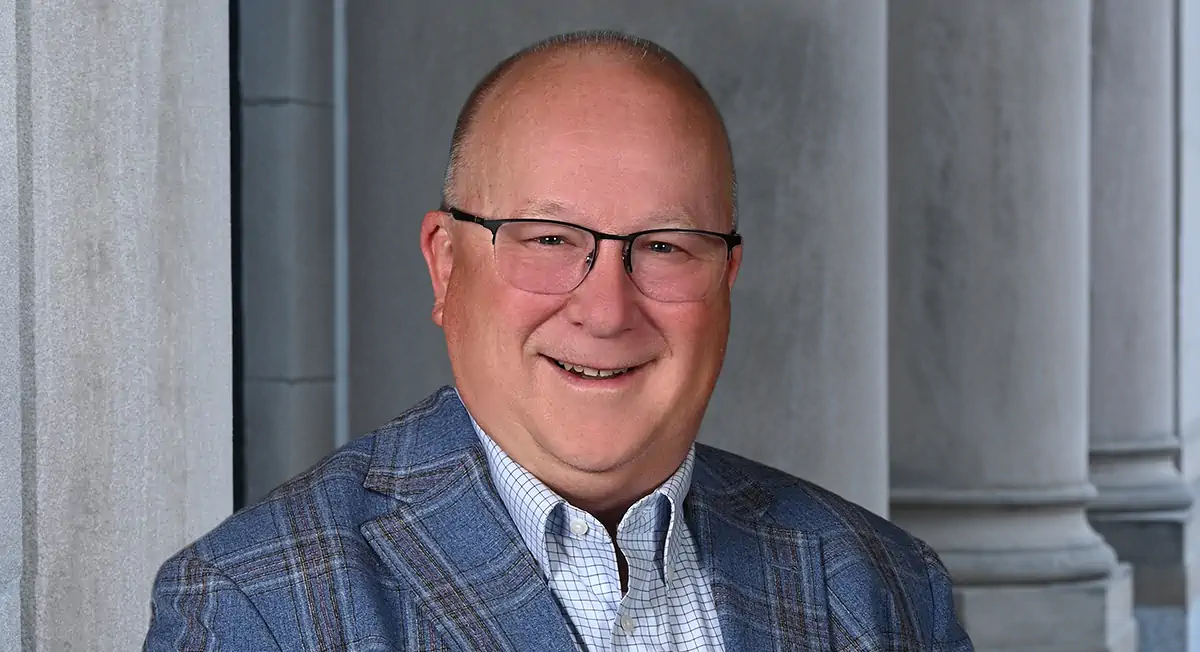
Doug Parrott has underwritten through nearly every major shift in the life insurance industry over the last 40 years, from paper files to predictive models. Few underwriters have experienced such a full arc of change. Fewer still have helped lead it.
As Doug approaches retirement (and Milliman IntelliScript marks its 25th anniversary), we sat down with him to reflect on how underwriting has evolved, what it takes to responsibly adopt new data and technology, and why the future of the profession depends as much on mindset and collaboration as it does on models and math. His perspective offers a rare view of the industry’s past and present—and what comes next.
Let’s start at the beginning. How did you get into underwriting?
I’m one of the few people I know who actively chose this career. Most people fall into it.
I was a finance major in college, back in the 80s. I was tight with one of my professors at Minnesota State and talked to him about a career in banking—arbitrage, to be precise. He told me that was “all title and no money.”
When he suggested insurance, I told him that I didn’t have a sales bone in my body. But he wasn’t thinking about sales. Instead, he sent me to a management professor who specialized in insurance. From my junior year on, I had my course set on underwriting. I’ve been in it for 41 years now.
How has the practice of underwriting changed over that time?
For the first 22 or 23 years of my career, it really didn’t change. You underwrote people, and you tried to protect your company from mortality slippage. We all used the same requirements, made decisions about what rate to offer, and so forth, based on similar information. MIB had been around for over 100 years. We all ordered SMA 20 or 28 labs. The next meaningful lab advancement was NT‑proBNP, which didn’t really come into play until the early 2000s.
But in the last 20 years things really started to change. I’ve been working with Milliman for—goodness gracious!—about 18 years. The company I was with at the time was an early adopter of Prescription Data. That truly changed everything.
When carriers first began using new digital assets, were they uneasy about them? Were there skeptics?
Yeah, absolutely. It took some trust to get there. Then reinsurer studies began coming out showing that electronic data was legitimate.
“Eligibility” became a new phrase. The insurance industry didn’t initially understand that simply being eligible for prescription drug coverage—even without any fills on file—was meaningful information. Without an actual result, without that green‑yellow‑red readout we got from Prescription Data, underwriters were concerned that it didn’t mean anything. Then RGA published a white paper that helped clarify eligibility’s mortality implications.
There are still aspects of new tools and digital assets that challenge traditional underwriting, and some smaller companies don’t know what they don’t know. Take predictive modeling, for example. Foresters is a medium‑sized company with a big‑company mindset. We’ve done our own mortality studies. I completely accept the math and science behind it, so we’re believers. But some smaller companies don’t have the resources—or perhaps the forward‑looking mindset. There will always be laggards.
Applying a new, disruptive technology can benefit your business, but bringing new tech onstream in a way that disrupts your own processes … not so much. How have you created an environment in which underwriters and others can stay open to new ideas and bring new technology on board without damaging processes and confidence?
We’ve been using Irix Risk Score for a couple of years, so I’ll use that as an example. It starts with more than just underwriting. Senior leadership, compliance, risk management—everyone has to be on board. You have to consider the range of experience and perspectives of the entire group. So I socialize new ideas with my leadership team first, and then we collectively present them to our teams.
I’m a big whiteboard presenter. I draw pictures and use analogies to make sure the message lands. I don’t dumb anything down—I tell them everything I know about how it works. But the discussion with underwriters is different from the discussion with risk or actuarial teams.
Speaking of other ways of thinking, it often seems that underwriters think in terms of causality, and actuaries in terms of probabilities. As a result, an underwriter might take every early death personally, whereas actuaries are more focused on the mortality of the entire pool. Are those two mindsets fundamentally at odds?
I’ve worked at companies where every time a contestable‑claim death list came out, underwriters immediately scanned it to see if they’d underwritten any of those people. I’ve never done that.
Adopting Risk Score brought underwriters closer to actuaries in our organization. To your point, they’d been underwriting case by case. Relative mortality scoring completely changed that mindset. We spent 12 weeks training our division, and I think we did a really good job shifting perspectives—from a single‑case view to one grounded in the law of large numbers. We explained why underwriting based on mortality scores meant approving cases we would have previously declined, and declining cases we would have previously approved. We walked through the science and the math behind it. That understanding is one of the biggest keys to success.
It seems as if Foresters is a place where underwriters and actuaries are on the same page. But would the industry as a whole be better off if there was a way to help those two professions see eye-to-eye? And if so, how could they accomplish that?
One hundred percent.
One way we do that is by getting underwriters involved on the actuarial side, and vice versa. I work closely with a great pricing actuary, and I’m nearly as involved in pricing as he is.
For example, when we were developing cut points for Risk Score, we initially applied adult cut points to juveniles—and we declined too many of them. I went back to the pricing team and explained that juveniles haven’t lived long enough to accumulate enough favorable mortality to offset adverse risk. As a result, we’re now developing different cut points for juveniles.
You have to be open, and you have to understand the model and the science. If you don’t, you’re going to get into trouble. If you set something up that’s going to hurt you, the field will always figure it out before you do. That’s why too much business isn’t necessarily something to celebrate; that’s when you need to step back and ask whether something is amiss. It’s possible someone has found an angle you didn’t anticipate.
One difference between traditional underwriting and predictive modeling is that in traditional underwriting, you basically begin with an assumption of best class, and any additional data that influences your decision has the effect of increasing mortality. Risk Score begins with an assumption of average mortality, then data influences the score both positively and negatively. How do you see it?
I think of it more as a puzzle. When you look at a case, you’re starting to put a puzzle together as far as what that person’s puzzle looks like, and you start adding pieces in. It depends on your mindset. I am a linear thinker, which may explain why I get along so well with actuaries.
So would you suggest underwriting as a career for other linear thinkers?
Not necessarily. I have people on my team who are linear thinkers, and others who are more conceptual—but they still arrive at good decisions.
When I’m hiring underwriting talent, I don’t care what someone’s background is. We can teach the technical skills. What I’m looking for is a decision‑maker. If someone can’t make decisions, they’re never going to be successful. Both linear and more “cloud‑based” thinkers can succeed—as long as they’re decisive.
Today, underwriters really need to understand relative mortality scoring. Someone who’s been underwriting for 20 years may question the credibility of predictive models compared to traditional methods. But once new data sources started emerging, I knew the best underwriters would also be strong data analysts.
Looking back on it, are you glad that you had your career when you had it? Or would you like to be starting out now?
I was fortunate to start when I did. I still remember the woman who trained me at my first company right out of college in 1985. She was about 10 or 11 years older than me and very old‑school.
But mortality hasn’t changed. At the end of the day, we’re still making educated guesses about when people will die and what price we need to charge for that risk. The methods are different—but the core challenge is the same.
I’ve had the best of both worlds: old‑school training paired with modern tools. The tools have changed the industry, but the real shift is mental. If you don’t learn to think in data and mortality, innovation will move on without you.